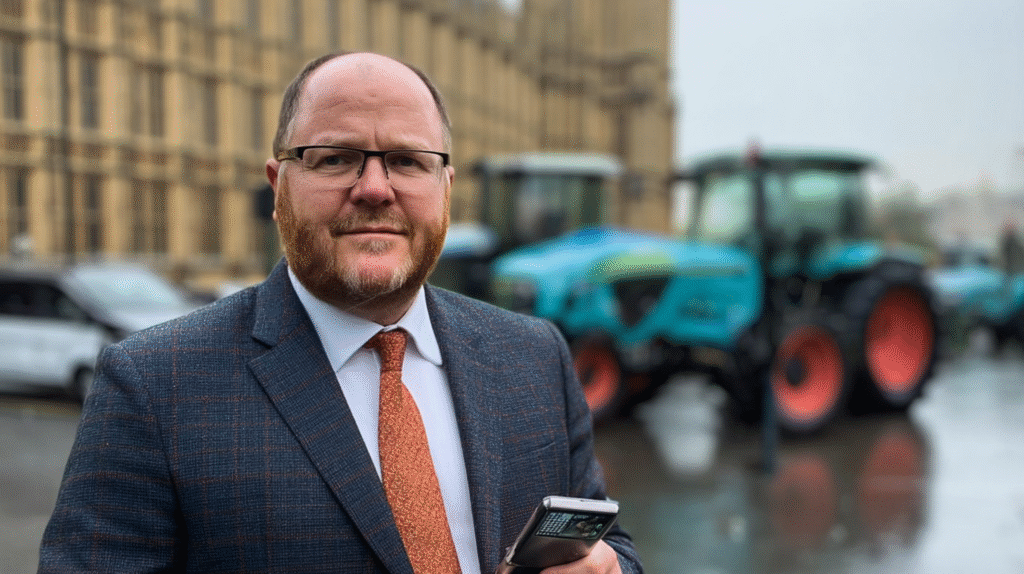
Former Conservative science minister George Freeman MP has called on the government to deliver an urgent policy shift that puts agritech investment at the heart of UK agriculture, warning the sector risks being “seriously neglected” without a major reset.
Speaking during a keynote address at the Croptec Show in Birmingham on 15 January, the Mid-Norfolk MP said the UK should treat agriculture as a key strategic industry, backed by stronger long-term support for innovation and on-farm adoption of new technology.
Mr Freeman, who chairs the All-Party Parliamentary Group on Science and Technology in Agriculture (APPGSTA), argued that the UK remains a global leader in agricultural science and research, pointing to the strength of its institutions and expertise. However, he warned there is still too little “translation” of world-class academic work into practical innovation on farms.
Reflecting on his time in government, Mr Freeman highlighted his role in creating the Government Agritech Strategy, including the launch of Agrimetrics, the agri-tech catalyst fund, and regional hubs designed to support sector growth. But he said more needs to be done to ensure investment and research directly benefit farmers, claiming: “I set up the regional agri innovation centres, and the scientists ‘stole’ all the money and took it back into the lab.”
He added that he wanted a new network of regional innovation farms, where producers could see practical examples of technology in use and understand what innovation could look like in their own sector.
On future land use and productivity, Mr Freeman reiterated the APPGSTA’s long-standing 30:50:50 ambition – producing 30% more food with 50% less environmental impact by 2050 – but warned that this would become harder if farmland continues to be lost. He referenced figures published by think tank Science for Sustainable Agriculture, which suggest the UK has lost 4.4% of its agricultural land area in the past 25 years, equivalent to 771,000ha.
Mr Freeman said: “If we carry on, we’re going to lose 23% of farmland by 2050 so you’re now trying to increase production on a smaller land area.”
He argued that existing policy does not sufficiently encourage innovation and productivity improvements, adding: “We don’t have a policy framework that encourages, rewards and supports [farmers] to deliver more for less.
In fact, policy in the last 20 years has been deliver less with less, for less.”
Mr Freeman also warned that without cross-party agreement and a significant change in direction, the consequences for farming and food security could be severe. He said: “This government is in danger of seeing family farms shut down, losing a great industry, losing a huge inward investment and export opportunity, and leaving us very vulnerable to food security shocks. That’s a pretty serious list of things you don’t want to happen.”