Artificial intelligence is moving deeper into the soft fruit sector, with a new forecasting platform promising to help berry growers plan crops, labour and supply with far greater precision.
GreenView AI, developed by Bitwise Agronomy, is designed to improve yield forecasting in strawberries, raspberries and blueberries by using video footage and machine learning to predict when fruit will be ready to harvest. The platform is already being used by The Summer Berry Company in West Sussex, where it is helping the business manage strawberry forecasting across 15 hectares.
For growers facing increasingly unpredictable weather, the timing could hardly be more relevant. Recent heat has brought an early start to the strawberry harvest, underlining just how quickly crop volumes can shift. For commercial berry businesses, a sudden surge or shortfall is not simply an agronomic inconvenience. It affects labour planning, packing, cold chain logistics, customer supply commitments, pricing and, ultimately, food waste.
Soft fruit has always been difficult to forecast accurately. Crops develop at different rates depending on variety, propagation, microclimate and weather conditions. Traditionally, growers have relied heavily on experience, crop walking and instinct. While that knowledge remains vital, GreenView AI aims to add a new layer of evidence by analysing footage captured during normal farm operations.
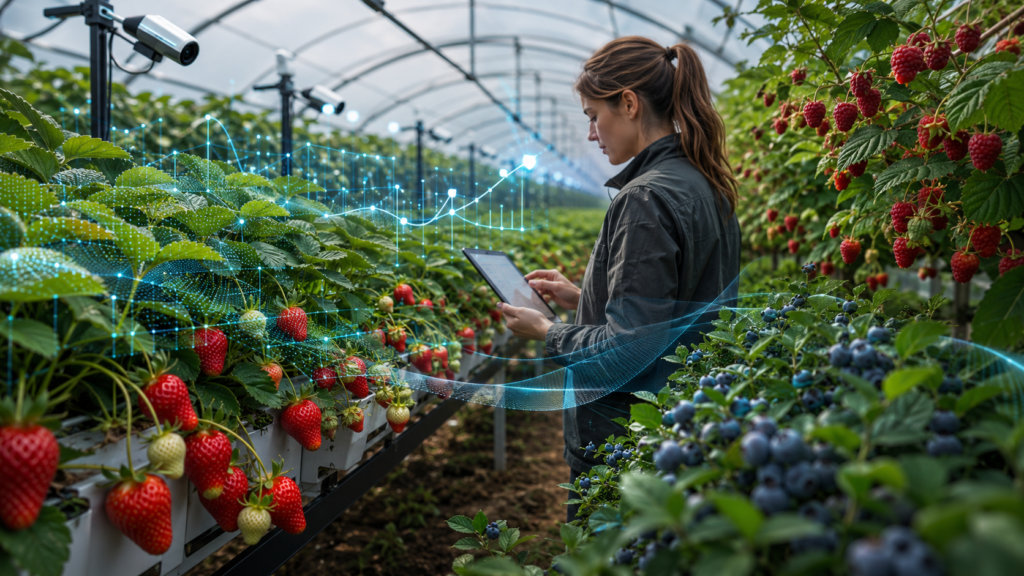
The system uses side-on crop footage, typically recorded using a GoPro or existing camera systems, before uploading the data to an intelligent dashboard. GreenView AI then produces yield forecast information within 12 hours, helping growers see what is coming through the crop and when it is likely to be ready.
Bitwise Agronomy says the technology can improve forecast accuracy to 90 per cent or more. The company says inaccurate forecasting can lead to major over or under supply, volatile returns and significant waste, particularly where supermarket programmes and labour requirements depend on reliable volume predictions.
The platform is already working at significant scale. In 2025, GreenView AI analysed more than two billion blueberries, 36 million strawberries and 34 million raspberries worldwide.
At The Summer Berry Company, which harvests around 8,500 tonnes of soft fruit a year, GreenView AI is being used alongside existing cameras installed on Saga UV robots, which are deployed for disease control. Footage from the robots is uploaded automatically, allowing the software to generate forecasts for the production team.
The company is currently monitoring three strawberry varieties with different propagation profiles across 15 hectares. The system produces five-week forecasts, supporting decisions around customer supply, picking labour, packing capacity and wider resource planning.
Production manager Liviu Palade said the technology is particularly useful in a season where extreme heat can bring large volumes forward quickly. He noted that with new varieties, growers need to be able to adapt and innovate, and said GreenView AI had so far produced strong yield predictions.
However, the system is not being presented as a replacement for grower expertise. Palade said every season is different and that, particularly early in the season, grower judgement remains essential. The value of AI lies in its ability to analyse large volumes of data across big areas and turn that information into usable forecasts.
For Bitwise Agronomy chief executive Fiona Turner, the wider opportunity is clear. As more growers adopt the system and more varieties are monitored across different UK conditions, the quality of the forecasting data is expected to improve further.
The development points to a broader shift in agritech: AI is no longer just a futuristic concept for agriculture. It is becoming a practical decision-making tool on commercial farms, helping growers reduce uncertainty in one of the most volatile parts of fresh produce production.
For berry growers under pressure from climate volatility, labour constraints and tight retail programmes, more accurate forecasting could prove a powerful advantage. In a sector where timing is everything, seeing the harvest before it arrives may soon become one of the most valuable tools in the field.