Innovation is no longer sitting politely at the edge of the food system. It is moving straight onto the plate.
As global resources tighten and populations rise, the pressure on food production is becoming impossible to ignore. The challenge is no longer simply to produce more food, but to produce it more intelligently: with higher yields, fewer inputs and lower environmental impact.
According to research cited by Business Traveller, the global population has already passed eight billion and is projected to reach 9.7 billion by 2050, with food production needing to double to meet demand. At the same time, conventional agriculture is being tested by soil degradation, extreme weather and growing competition for land.
The answer, increasingly, lies in a new generation of agri-tech systems designed to make food production more efficient, resilient and localised. But the shift is not without complexity.
Land is not just a production asset. It supports biodiversity, regulates climate and underpins entire ecosystems. That means the future of food cannot be framed simply as a race to intensify production. It must balance productivity with protection.
A study published in Nature Food last year underlined the scale of the challenge. It found that only one country, Guyana, could feed its population across all seven essential food groups from domestic production alone. Its fertile land, low population density and biodiversity make it an exception rather than a model that can easily be copied elsewhere.
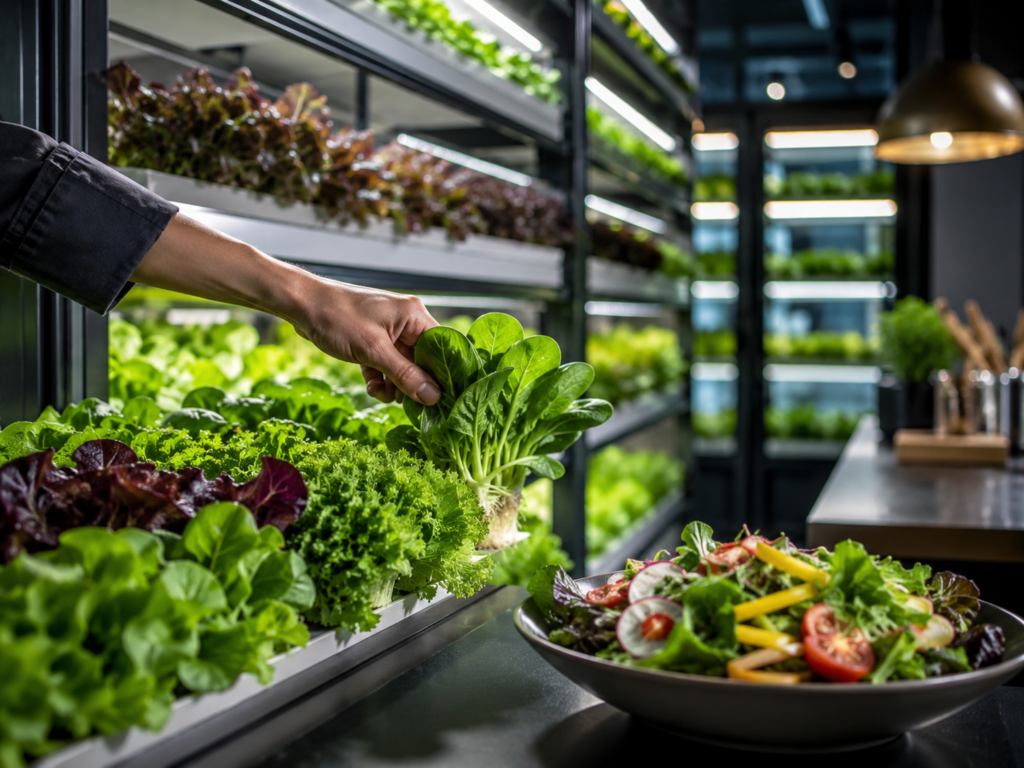
This is where controlled-environment agriculture, hydroponics and vertical farming are gaining attention. These systems use nutrient-rich water rather than soil and grow crops in carefully managed environments. Vertical farms take the concept further by stacking crops in layers, making far greater use of space and enabling production in urban or unconventional locations.
Companies including AeroFarms in the US and InstaGreen in Europe are among those developing indoor farming systems to supply supermarkets, restaurants and even airlines. The appeal is clear: year-round production, reduced dependence on pesticides, lower water use and the ability to grow fresh produce close to the point of consumption.
But the sector is still finding its commercial footing. AeroFarms filed for bankruptcy in 2023 before restructuring under new ownership, while other early pioneers have also faced financial pressure. The technology may be compelling, but the business models are still maturing.
That has not stopped experimentation. In Dundee, the James Hutton Institute’s Advanced Plant Growth Centre is using vertical growth towers to develop resilient crops under fully controlled light, temperature and humidity conditions. In Seoul, idle underground spaces within the metro system are being leased to Farm8, a start-up producing vegetables in controlled indoor environments.
These examples show how unused spaces can be repurposed for food production. Basements, tunnels, rooftops and former industrial units are no longer just urban leftovers; they are becoming part of the future food map.
Yet vertical farming is not a complete replacement for traditional agriculture. Professor Duncan Westbury, dean of land and property management at the Royal Agricultural University, told Business Traveller that vertical farming contributes nothing to biodiversity unless structures are designed with green roofs. Much of the UK’s biodiversity is linked to the farmed environment, he noted, and cannot simply be replicated indoors.
That warning matters. The future of food will not be solved by technology alone. It will depend on combining innovation with land stewardship, biodiversity protection and smarter use of natural resources.
Some of the more unexpected examples are already coming from the travel sector. London Gatwick Airport manages more than 90 hectares of woodland, wetland and grassland, while Heathrow maintains around 170 hectares dedicated to conservation. Munich Airport’s meadow habitats near runways have also become important breeding grounds for endangered bird species.
Airlines and hotels are also exploring how controlled growing can strengthen supply chains. Emirates Flight Catering operates Emirates Bustanica in Dubai, described as the world’s largest vertical farm, producing greens for inflight meals. Singapore Airlines has previously worked with AeroFarms to bring farm-to-plane produce onto selected flights.
Hotels are taking similar steps. Fairmont Singapore operates an aquaponics farm that combines fish farming with hydroponic crop production, supplying fresh ingredients directly to its kitchens. Meanwhile, social enterprise Edible Garden City has created more than 270 food gardens across Singapore, including projects at Marina Bay Sands and PARKROYAL COLLECTION Marina Bay.
For consumers, the result may be subtle at first. A salad leaf on an aircraft meal, a micro-herb in a hotel restaurant or a fresh ingredient grown beneath a city street may not look revolutionary. But behind it lies a much bigger shift.
Food production is becoming more local, more controlled and more closely connected to technology. The winners will be those who can make innovation commercially viable while respecting the environmental systems that farming still depends upon.
The future of eating, in other words, will not be built in a single field, glasshouse, warehouse or rooftop. It will be built across all of them.