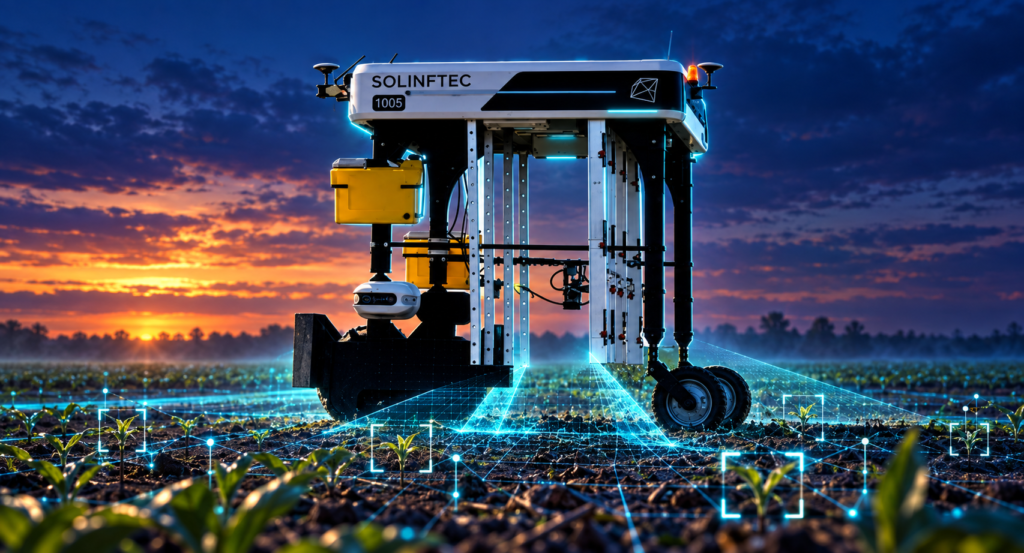
Solinftec reports more than 1,700 autonomous refills as its expanding robot fleet targets the everyday workload behind precision crop management.
Agricultural robotics company Solinftec has reported progress in automating a task that can interrupt driverless fieldwork: replenishing the robot’s spray supply.
In an update published on 26 August, the company said its autonomous Refill Station had completed its first full commercial growing season. The system enables a Solix robot to dock, replenish its supply and resume fieldwork without a farmer making the journey to refill it.
By July 2026, the robots had completed more than 1,700 autonomous refills, according to Solinftec.
The company reported that more than 100 Solix robots were operating across 13 US states and Puerto Rico, covering 55,427 acres and monitoring over 95 million plants individually.
It also reported an average reduction in chemical use of 85 per cent. These are company-reported results; the announcement does not provide an independently audited assessment or a detailed comparison methodology.
Solinftec expects to deploy approximately 200 robots and 80 additional Refill Stations for the 2027 growing season. These remain planned deployments.
Solix combines crop scouting with targeted spraying. According to the company’s product information, the platform maps conditions at plant level and uses that information to treat the areas requiring attention. Early weed detection and treatment are central to its approach.
The solar-powered machine is designed to operate during both daylight and darkness. Solinftec markets the platform for crops including maize, soyabeans, wheat and cotton, as well as speciality crops.
For growers assessing automation, the significance of autonomous refilling extends beyond the robot’s ability to navigate a field.
A machine may perform its main task without a driver while still requiring regular visits for replenishment, maintenance or troubleshooting. Automating one of those supporting jobs could reduce interruptions and free staff to work elsewhere.
That makes refilling a useful test of practical autonomy. The relevant question is how much of the complete working day a system can handle reliably, alongside how accurately it performs an individual operation.
However, the number of automated refills alone cannot establish the financial return for a particular farm. That would also depend on equipment costs, field layout, workload, supervision requirements and performance under local growing conditions.
Solinftec’s update points to a promising direction for agricultural robotics: extending automation beyond movement and spraying to the routine support tasks that determine whether a machine can keep working.