
As Britain accelerates investment in artificial intelligence, data centres are becoming essential to agriculture, food supply chains and the wider economy. Their security, energy use and resilience will help determine whether that promise can be delivered.
Britain is pressing ahead with an ambitious expansion of artificial intelligence infrastructure, signalling that data centres are no longer simply the hidden machinery of the digital economy but essential assets on which future prosperity and resilience may depend.
Reporting by the Financial Times, covered by Engadget, indicates that ministers do not intend to slow the construction of AI data centres despite growing concerns over electricity demand and local environmental pressures. The Government’s Data Centre Covenant, published on 28 October 2026, links additional support for strategically important developments to security, sustainability and benefits for communities.
The invisible infrastructure behind the next agricultural revolution
Precision farming, autonomous machinery, crop-monitoring satellites, robotics and predictive analytics are changing the way food is produced. Behind many of these innovations lies the processing power, storage and connectivity provided by data centres.
Imagine a farm where satellite imagery identifies crop stress, irrigation responds to weather forecasts, and AI models flag pest risks before serious damage occurs. Some decisions can be made locally, but cloud and data centre infrastructure can support the training of models, analysis of large datasets and coordination between locations.
The implications extend beyond the farm gate. Food manufacturers, logistics providers, importers and retailers increasingly rely on digital platforms for traceability, temperature monitoring, stock management and forecasting. The more interconnected those systems become, the more important resilient infrastructure becomes.
Britain targets a major increase in computing capacity
The UK Compute Roadmap forecasts a need for at least 6GW of AI-capable data centre capacity by 2030 — described by the Government as a threefold increase on capacity available when the roadmap was prepared. This is a capacity forecast, not a measurement of electricity consumed.
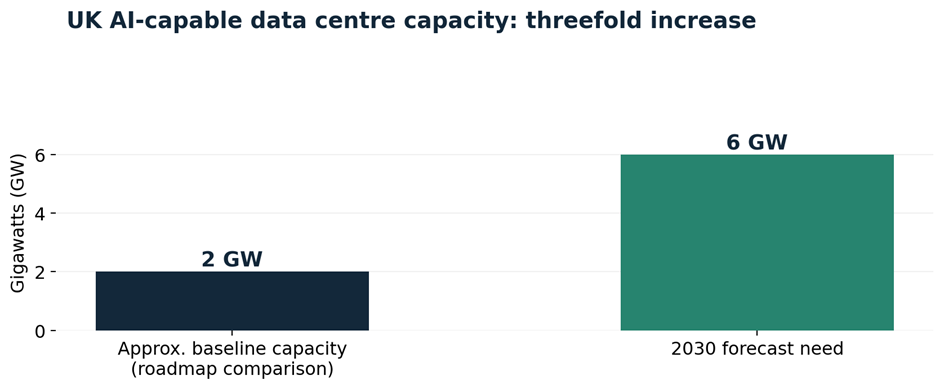
SOURCE: UK Government, UK Compute Roadmap (2025, updated 2026). The approximately 2GW baseline is inferred from the Government’s “threefold” comparison; the 6GW figure is its 2030 forecast.
AI Growth Zones are intended to help deliver strategically important infrastructure. The Data Centre Covenant sets expectations around grid costs, efficient use of resources, community benefits, British jobs and national resilience. For agritech businesses, more domestic capacity could improve access to computing infrastructure, but UK location alone does not guarantee data sovereignty or security.
An increasingly attractive target for disruption
A serious cyberattack, prolonged electricity failure, cooling fault or physical security incident affecting a data centre can disrupt many organisations at once, particularly when they depend on the same cloud provider or platform.
For the food and farming sectors, possible consequences include interrupted logistics planning, unavailable warehouse software, delayed electronic documentation and loss of access to systems monitoring the movement or condition of perishable products. These are operational risks, not claims that a specific food supply chain has experienced such an event.
The UK designated data centres as Critical National Infrastructure in 2024. The Government is also pursuing a stronger cyber-resilience regime, including proposals to bring qualifying data centres within regulatory requirements for risk management and incident reporting.
| Threat or pressure | Why it matters | Protective response |
| Cyberattack or ransomware | Cloud systems and shared services may become unavailable | Segmentation, monitoring, incident response and recovery testing |
| Power and cooling failures | Computing services can stop or degrade | Backup power, cooling redundancy and maintenance |
| Physical security incident | Facilities and network infrastructure may be damaged | Access controls, surveillance and site resilience |
| Concentrated service dependence | A single outage can affect many organisations | Supplier diversification and offline contingencies |
The energy challenge: powering progress responsibly
The International Energy Agency’s updated assessment projects worldwide data centre electricity consumption rising from about 485TWh in 2025 to around 950TWh in 2030. That is an increase of roughly 96%, and the 2030 figure is projected to represent approximately 3% of global electricity demand.
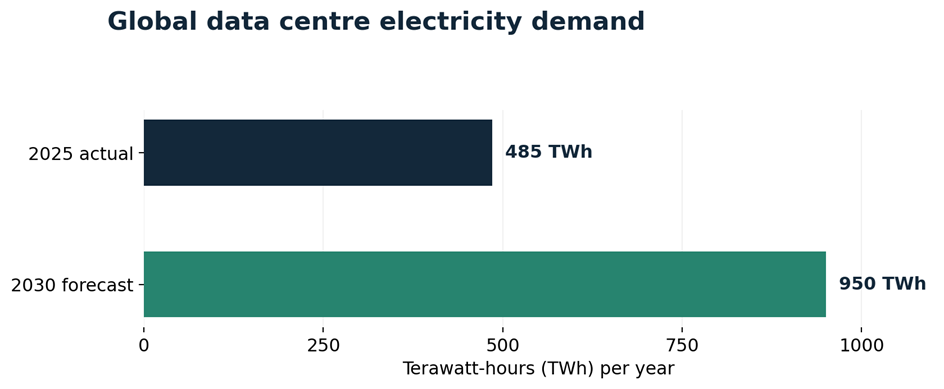
SOURCE: International Energy Agency, Key Questions on Energy and AI (2026). The 2030 figure is a forecast, not an observed result.
Data centres require reliable power, cooling and, depending on their design, water. In regions with constrained resources, developments may compete with other economic uses, including agriculture. The Government’s Covenant therefore encourages efficient cooling, reduced demand for public water supplies, annual reporting and reuse of waste heat where practical.
Waste heat could, in some locations, be captured for greenhouse heating, industrial processes or district heating. Whether a project works commercially depends on the temperature of the heat, the distance to potential users and the infrastructure required.
What the figures mean for farming and food
| Figure | What it describes | Source |
| 6 GW | UK forecast need for AI-capable capacity by 2030 | UK Compute Roadmap |
| 3× | Government’s approximate increase relative to its baseline | UK Compute Roadmap |
| 485 TWh | Global data centre electricity consumption in 2025 | IEA |
| 950 TWh | Global data centre electricity demand forecast for 2030 | IEA |
| ~3% | Projected global electricity demand share in 2030 | IEA |
Protection must be designed in from the beginning
Cyber defences, physical access controls, backup power, cooling redundancy, diverse connectivity, tested disaster recovery and coordination with critical suppliers all matter. So does avoiding excessive dependence on a single provider or geographic region.
Agritech companies should consider how essential operations would continue if cloud connectivity failed, where backups are stored, how quickly services could be restored and what commitments appear in suppliers’ contracts. In practice, resilience must reach from the data centre all the way to the field, packhouse and distribution hub.
A defining opportunity for British agritech
More computing capacity could accelerate predictive crop models, autonomous machinery, precision irrigation, advanced breeding research and intelligent logistics. Yet physical capacity alone is not enough. Affordable access, strong rural connectivity, interoperable data, technical skills and evidence of real-world returns will determine whether investment delivers measurable value.
Data centres may not have the visibility of robotic harvesters or AI-enabled tractors, but they are becoming the digital foundations of intelligent agriculture. Britain’s task is not simply to build more of them: it is to make them secure, sustainable, efficient and resilient.
The future of farming will increasingly be shaped by intelligence generated far beyond the field. Protecting the infrastructure behind that intelligence may prove just as important as developing the technology itself.
Sources and further reading
- UK Compute Roadmap — https://www.gov.uk/government/publications/uk-compute-roadmap/uk-compute-roadmap
- Data Centre Covenant, 28 October 2026 — https://www.gov.uk/government/publications/data-centre-covenant/the-data-centre-covenant
- International Energy Agency: Key Questions on Energy and AI — https://www.iea.org/reports/key-questions-on-energy-and-ai/executive-summary
- UK Parliament statement on data centre environmental resilience — https://questions-statements.parliament.uk/written-statements/detail/2026-10-28/HCWS426
- Engadget: UK plans for AI data centres — https://www.engadget.com/2310304/uk-has-no-plans-to-slow-down-ai-data-center-construction/