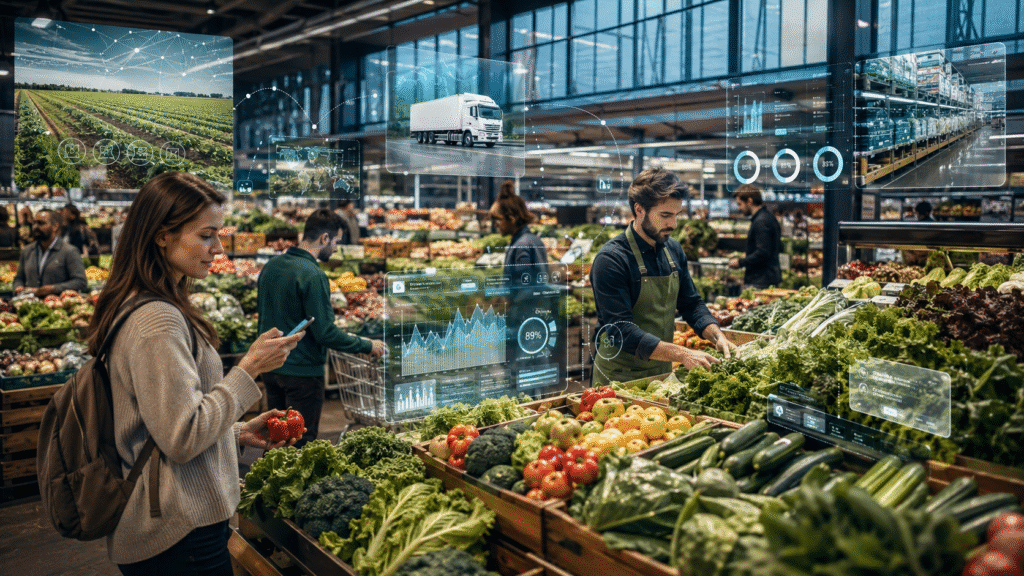
Artificial intelligence is rapidly moving from the back office to the beating heart of the UK grocery market, reshaping how retailers predict demand, manage fresh food, personalise offers and compete in an increasingly price-sensitive sector.
For years, AI in food retail was talked about largely in terms of futuristic stores, automated checkouts and frictionless shopping. Today, its most significant impact is more practical and far more powerful: helping grocers make better decisions in real time across complex, high-volume supply chains.
The clearest battleground is forecasting. Fresh produce, meat, dairy and bakery all depend on getting availability right without tipping into costly waste. Machine learning tools can analyse historic sales, weather patterns, promotions, seasonal behaviour, local events and online demand signals to help retailers anticipate what shoppers are likely to buy, store by store and day by day. For suppliers, that shift is significant. It means ordering patterns may become sharper, faster and less forgiving, with better data flowing through the chain but also greater pressure to respond at speed.
Sainsbury’s has already highlighted the importance of machine learning in food forecasting, reporting in its 2025 annual report that moving food products onto a machine learning forecasting platform helped improve availability over four years. That is the kind of operational gain that matters in grocery, where even small improvements in availability can protect sales, reduce waste and strengthen customer trust.
Tesco is also pushing further into AI. In April 2026, the retailer announced a strategic partnership with Adobe to use AI and agentic AI capabilities to better interpret and anticipate customers’ needs, with the aim of creating more personalised shopping experiences. It has also begun trialling an AI assistant in its app, initially with colleagues, designed to help customers with meal planning and personalised recipe ideas.
This points to another major shift: grocery retail is becoming more individualised. Loyalty schemes have already given supermarkets deep insight into shopping behaviour. AI allows that data to be used more dynamically, tailoring offers, recipes, reminders and product recommendations to individual households. For shoppers, that may mean more relevant value. For brands and suppliers, it raises the stakes around visibility, retail media and data-led category planning.
Automation is also advancing behind the scenes. Ocado Group says its Smart Platform uses artificial intelligence, robotics and automation to tackle the complexity of online grocery, including varied basket sizes, thin margins and multiple temperature regimes. Although the economics of automated fulfilment remain challenging, the direction of travel is clear: retailers are searching for ways to make online grocery more efficient, scalable and profitable.
The opportunity for the wider food and farming sector is substantial. Better demand forecasting can reduce gluts, improve planning, cut unnecessary miles and help growers align production more closely with market need. AI could also support dynamic pricing, quality assessment, shelf-life prediction and more resilient sourcing decisions during weather disruption or supply shocks.
But this is not a simple success story. AI systems are only as good as the data behind them, and poor implementation can create volatility for suppliers. There are also concerns around transparency, workforce impact and whether smaller producers have the digital infrastructure to keep pace.
The future UK grocery market will not be run by AI alone. It will be shaped by retailers, suppliers and growers that know how to combine data intelligence with human judgement. The winners will be those that use AI not as a shiny add-on, but as a practical tool to build a fresher, leaner, more responsive food system.