
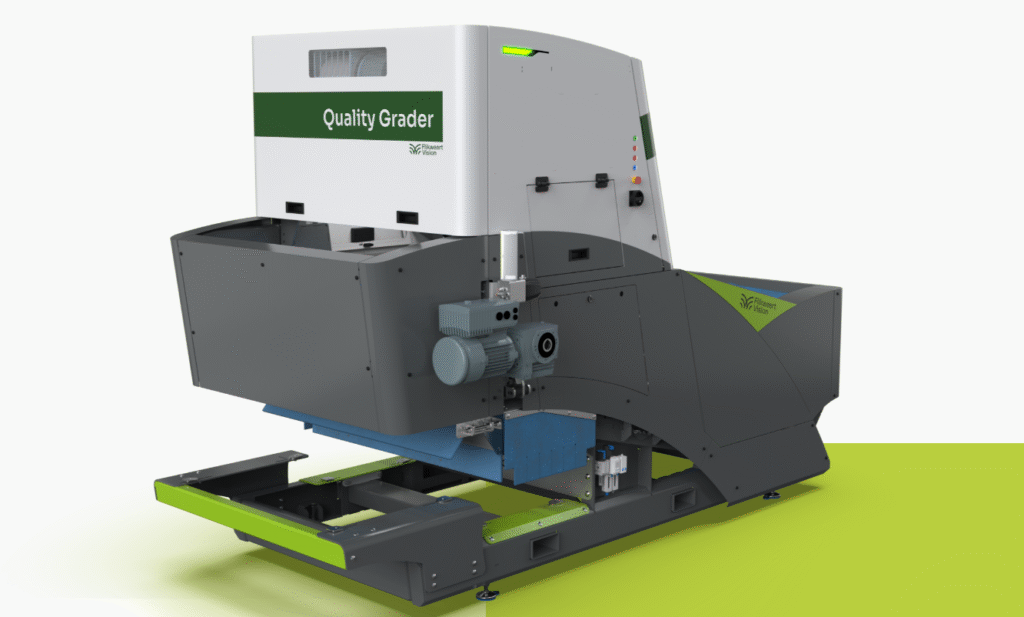
Dutch agritech specialist Flikweert Vision is accelerating the shift towards intelligent automation in post-harvest handling, with its flagship QualityGrader platform bringing AI-driven precision to one of the sector’s most labour-intensive processes.
Developed from a practical farming background, the company has positioned itself at the forefront of optical sorting technology for potatoes and onions—two globally significant crops where quality consistency is critical to both market value and supply chain efficiency.
Tackling one of agriculture’s most persistent bottlenecks
Quality grading has traditionally relied on manual inspection—an approach widely regarded as time-consuming, inconsistent, and increasingly difficult to sustain amid labour shortages.
Flikweert Vision’s QualityGrader addresses this challenge head-on by automating the inspection process using artificial intelligence and advanced imaging systems. The machine captures multiple images of each individual product using industrial RGB cameras, before AI models assess quality based on predefined tolerances and real-world data inputs.
The result is a fully automated “accept or reject” decision-making process, delivering consistent, objective grading at scale—something manual systems struggle to replicate reliably.
High-throughput automation with real-world impact
Designed for daily use by growers and processors, the QualityGrader combines speed with precision. Depending on configuration, the system can process up to 30 tonnes per hour, while offering multiple output streams to separate premium product, lower-grade produce and foreign material.
This capability is already translating into tangible operational gains. The technology reduces labour dependency, streamlines workflows and improves overall efficiency in grading lines—benefits that are becoming increasingly vital as producers look to optimise margins and maintain competitiveness.
Recent installations on farms have demonstrated improved workflow stability and positive feedback from operators, highlighting the machine’s practical integration into existing operations.
Built for scalability and continuous improvement
A key strength of the QualityGrader lies in its adaptability. Available in multiple working widths and configurable with additional ejection units, the platform can be tailored to different operational scales and requirements.
Importantly, the system is underpinned by continuously evolving software. As AI models are trained on increasing volumes of real-world data, grading accuracy improves over time—ensuring that even earlier installations benefit from ongoing technological advancements.
This data-driven evolution reflects a broader trend within agritech, where machine vision systems are moving beyond simple inspection towards increasingly sophisticated decision-making capabilities.
A global footprint in a rapidly advancing sector
Since its launch in 2021, the QualityGrader has seen rapid international uptake, with hundreds of units deployed across Europe, North America and beyond.
The company’s growth underscores rising demand for automation solutions that can deliver both efficiency gains and consistent quality control—two factors that are becoming non-negotiable in modern fresh produce supply chains.
The future of intelligent grading
Looking ahead, Flikweert Vision is continuing to expand the capabilities of its platform, with developments expected to include more advanced classification features such as size grading alongside visual quality assessment.
As machine vision technology continues to evolve, its role in agriculture is set to deepen. By combining imaging systems with AI-driven analysis, solutions like the QualityGrader are not only replacing manual processes but redefining what precision and consistency look like in post-harvest operations.
For a sector under pressure to deliver more with less, that shift could prove transformational.
