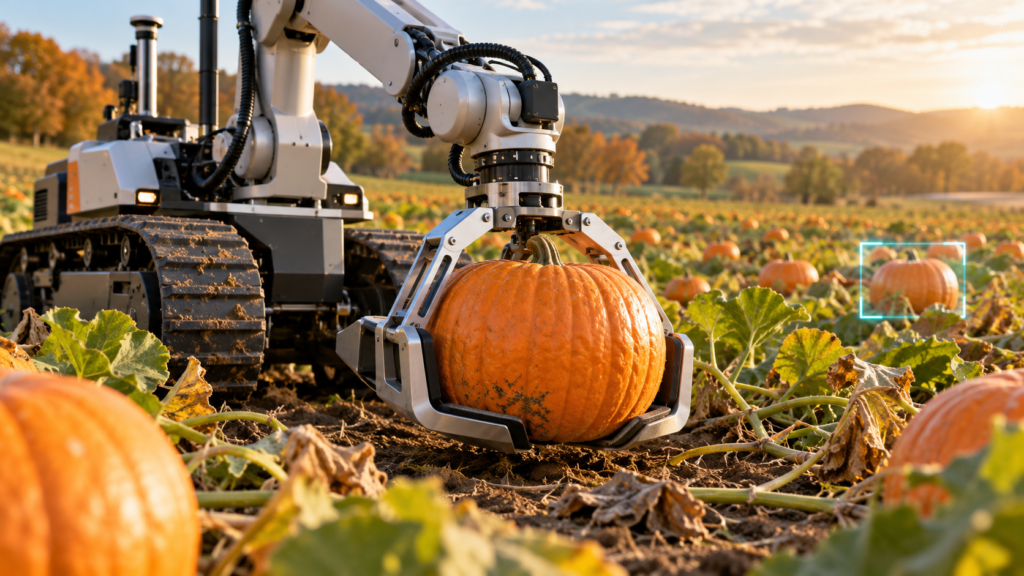
A robotic system tested in a pumpkin field has demonstrated how artificial intelligence could help reduce the physical demands of handling heavy crops — while revealing the practical obstacles that still need solving.
Research highlighted by Maryna Kuzmenko in her LinkedIn article, AI for Pumpkins: A Robot for the Heaviest Harvest Job, explores a targeted application for agricultural automation: lifting and moving pumpkins.
The underlying study, by Liangliang Yang, Tomoki Noguchi and Yohei Hoshino at Japan’s Kitami Institute of Technology, was published in Computers and Electronics in Agriculture in 2024.
The researchers developed a pick-and-place system combining a tracked vehicle, a collaborative robotic arm and a specially designed gripping hand. AI identifies pumpkins, while an RGB-D camera supplies colour and depth information to locate them in three dimensions.
The team compared YOLO object-detection models from versions 2 to 8 and developed a calibration method to translate camera measurements into positions the robotic arm could use.
Outdoor field experiments achieved fruit-detection accuracy above 99% and picking success above 90%. However, pumpkins surrounded by excessive vines could not be grasped successfully.
For growers assessing automation, that distinction matters. Recognising a crop and successfully handling it are separate challenges: a robot can identify its target accurately yet still struggle to reach or lift it.
The practical implication is that field conditions deserve as much attention as the AI model. Vine management, access to individual fruits and the way harvesting operations are organised could all influence whether such a system becomes useful on a commercial farm.
For Agritech Future readers, the research offers an example of automation aimed at a specific physical task. The next questions concern implementation: how much labour it could save across a working day, what supervision it would require and whether those benefits would justify its cost.
Source acknowledgement: This article draws on the research highlighted by Maryna Kuzmenko in her original LinkedIn article. The original study is Development of a pumpkin fruits pick-and-place robot using an RGB-D camera and a YOLO based object detection AI model, by Liangliang Yang, Tomoki Noguchi and Yohei Hoshino.