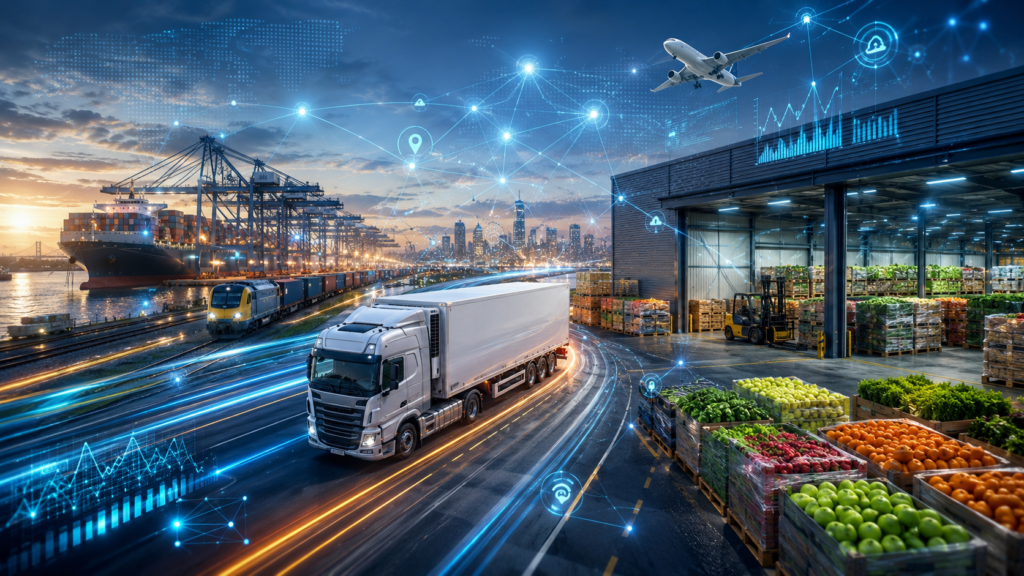
Sensor technology and artificial intelligence are beginning to reshape the way goods move across the UK, offering fresh opportunities to improve efficiency, resilience, safety and sustainability across freight, warehousing, ports and cold-chain operations.
For the UK’s food and fresh produce sectors, the potential is particularly significant. Logistics is no longer simply about getting goods from A to B. It is increasingly about understanding, in real time, where products are, what condition they are in, how transport assets are performing and where disruption may appear next.
The Department for Transport’s Future of Freight plan identifies data and technology as one of five priority areas for the long-term development of the UK freight sector. It highlights the importance of building a more efficient, resilient and environmentally sustainable freight system, with innovation expected to play a central role.
That shift is already under way. The Parliamentary Office of Science and Technology has reported that digital freight technologies now include connected sensors, navigation devices, cloud platforms, automated vehicles, robotics and AI tools capable of simulating assets and predicting maintenance needs. These technologies, it says, have the potential to cut costs, reduce congestion and carbon emissions, and provide greater transparency across supply chains.
In practical terms, sensors can monitor vehicle location, fuel use, driver behaviour, temperature, humidity, vibration, equipment performance and warehouse conditions. AI can then analyse that information to support better route planning, predict delays, identify maintenance risks, optimise warehouse flows and flag problems before they become expensive failures.
This could be especially valuable for temperature-sensitive supply chains. Fresh produce, frozen food, flowers, plants, pharmaceuticals and other perishable goods depend on consistent handling and tightly controlled environments. In the cold chain, even small temperature deviations can affect quality, shelf life and food waste. Real-time sensor monitoring, combined with predictive analytics, can give logistics operators earlier warning of equipment faults, route disruption or temperature excursions.
Government-backed innovation is helping to move some of these technologies from theory into live freight environments. The Department for Transport has dedicated £10 million to the Freight Innovation Fund, delivered by Connected Places Catapult, to support SMEs trialling technologies that address challenges including efficiency, decarbonisation, waste reduction and workforce upskilling.
The programme has already supported more than 44 SMEs and 44 real-world trials across four cohorts. Technologies trialled include lightweight trailers, electric trailers for cycle logistics and sensors designed to improve the wellbeing of staff working at ports.
One example is Zizo Confluence, an AI platform developed with support from the Freight Innovation Fund accelerator. The system brings together operational data and a large language model, enabling users to ask questions of their business data and identify opportunities for improvement. It has been trialled with Welch Group and Portsmouth International Port, including work to interrogate transport management data, warehouse operations, vehicle performance and carbon consumption.
Another project, from SpatialCortex, uses wearable sensors to help reduce manual handling risks in freight, warehousing and port environments. The technology monitors workers’ posture and movement, helping employers understand how risks evolve across a shift and target training or process changes more effectively.
For the wider logistics sector, the prize is a more connected operating model. Instead of relying on manual reports and hindsight, operators can use live data to make faster, evidence-led decisions. Ports can understand peak vehicle flows. Hauliers can identify underperforming routes. Warehouses can improve picking and storage. Cold-chain operators can protect product quality. Retailers and suppliers can gain better visibility of where delays and losses are occurring.
But the transition is not without barriers. POST has warned that wider adoption depends on stronger data-sharing infrastructure, sector-wide process standardisation, cybersecurity, communications coverage and appropriate regulation. Logistics UK has also highlighted the need for upskilling and reskilling, arguing that AI will change roles across the sector but should not simply be viewed as a threat to jobs.
The message for UK logistics is clear: sensor technology and AI are not magic wands, but they are powerful tools when built on reliable data, practical industry collaboration and people who know how to use them. For agritech, fresh produce and food supply chains, that combination could prove critical.
As pressures from labour shortages, climate disruption, border complexity, energy costs and customer expectations continue to build, smarter logistics may become one of the most important frontiers in UK food resilience. The future of the supply chain is not just faster; it is monitored, measured, predictive and, increasingly, intelligent.