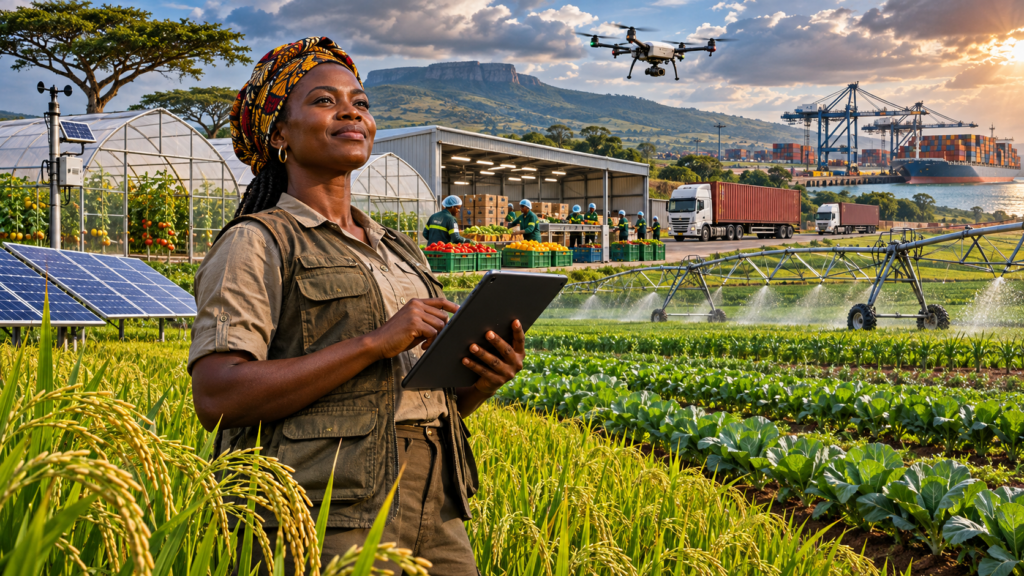
Digital innovation, smarter financing and better-connected supply chains could help transform African agriculture, reduce dependence on food imports and unlock significant opportunities in international markets.
Africa’s ambition to become a more influential player in the global food supply chain is gathering momentum, with a $650 million investment initiative in West Africa aimed at strengthening domestic agricultural production and improving food security.
The investment comes as a growing number of African agritech businesses demonstrate how digital platforms, data-driven farming and innovative financing models could overcome some of the structural barriers that have historically prevented the continent from realising its agricultural potential.
The $650 million Resilient Rice Value Chain Development Project (REWARD), launched by the Economic Community of West African States (ECOWAS), is supported by the African Development Bank and aims to strengthen production, processing and marketing while improving the competitiveness of locally grown rice.
Connecting Farmers with Global Markets
Ghana is emerging as a compelling example of how agritech can bridge the gap between smallholder farmers and international commercial opportunities.
Desmond Koney, chief executive of Ghanaian agritech company Complete Farmer, has highlighted the importance of improving access to finance, developing stronger agricultural supply chains and connecting growers with a wider range of buyers.
For many African farmers, the challenge is not simply growing more food, but securing the resources, technical expertise and commercial relationships necessary to make farming a profitable and sustainable enterprise.
Complete Farmer is addressing these challenges through an integrated digital platform connecting growers, agricultural suppliers and international buyers.
The company launched its CF Grower and CF Buyer platforms in June 2026, offering farmers access to production support, agricultural inputs and data-led insights, while providing buyers with greater visibility and traceability across their sourcing operations.
Its network now encompasses more than 60,000 farmers and 1,000 global agricultural commodity buyers, according to the company.
Financing the Next Generation of African Agriculture
Access to affordable finance remains one of the most significant obstacles to agricultural modernisation across the continent.
Without sufficient working capital, farmers can struggle to invest in quality seeds, crop nutrition, irrigation systems, mechanisation and emerging technologies that could substantially improve productivity.
In September 2026, Complete Farmer secured a $2.4 million convertible loan backed by the International Finance Corporation (IFC) and the Business Investment Financing Track, alongside a further $660,000 in technical assistance and grant support.
The company aims to extend the reach of its platform to 240,000 farmers by 2030, demonstrating the scale of ambition within Africa’s emerging agritech sector.
Breaking Down Cross-Border Barriers
The African Continental Free Trade Area (AfCFTA) could also play a pivotal role in accelerating agricultural transformation.
Greater regional integration could enable agritech businesses to expand beyond domestic markets, facilitate more efficient cross-border trade and create opportunities for growers to participate in larger, better-connected supply networks.
For international food buyers, the development of digitally enabled African supply chains could offer opportunities to diversify sourcing, improve supply resilience and establish closer relationships with producers.
However, investment in agricultural technology must be accompanied by improvements in transport infrastructure, cold chain facilities, storage, connectivity and quality assurance if these opportunities are to be fully realised.
Turning Innovation into Agricultural Impact
The real measure of Africa’s agritech revolution will not be the number of platforms launched or the volume of investment secured, but the tangible improvements delivered at farm level.
Higher yields, reduced post-harvest losses, stronger farmer incomes and more reliable access to markets will be critical indicators of success.
Technologies such as artificial intelligence, remote crop monitoring, precision irrigation and digital traceability could all contribute to this transformation, provided they remain accessible, affordable and commercially relevant to growers.
For technology developers, investors and international food businesses, Africa represents an increasingly important frontier for innovation, investment and collaboration.
The continent has an opportunity to move beyond traditional agricultural models and develop digitally connected supply chains capable of responding to the demands of an increasingly complex global food system.
The ambition is not simply to produce more food, but to build a more productive, resilient and commercially connected agricultural economy capable of feeding its own growing population while becoming an increasingly competitive supplier to the world.
If investment can be translated into practical, scalable solutions that deliver measurable benefits for farmers, Africa’s agritech revolution could help reshape the geography of global food production in the decades ahead.