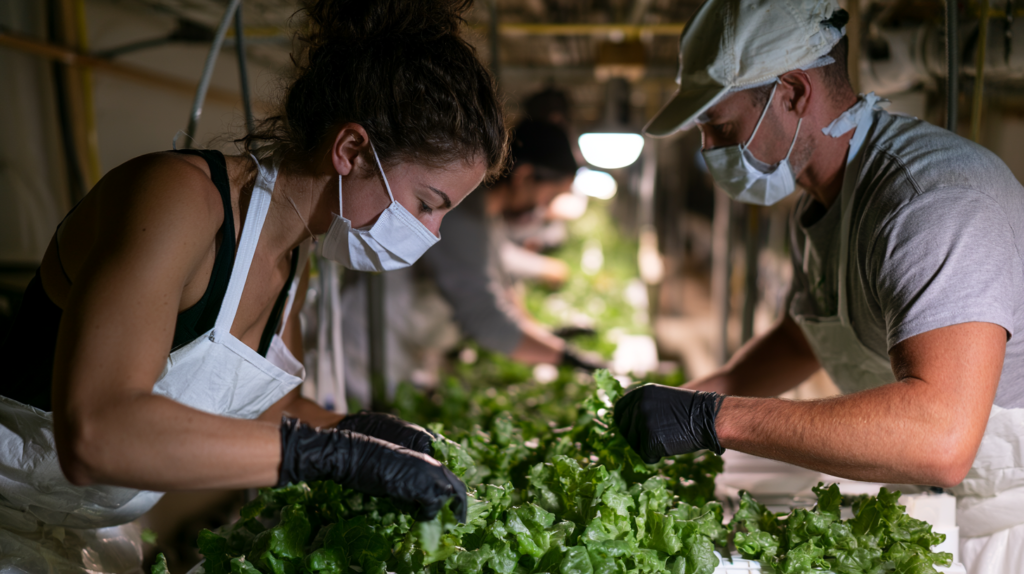
Over a kilometre below the North Yorkshire moors, in a working polyhalite and salt mine, researchers have just started growing food in what is being described as the world’s deepest farm. It is an unusual place to look for answers to one of Britain’s most persistent anxieties — how to keep the country fed as the weather it depends on grows less predictable — but the logic behind it is simple. If the surface is becoming harder to farm reliably, what if the answer is to go down instead of out?
A kilometre down, and rising
The University of Sheffield, working with vertical farming operator Farm Urban, has begun a 12-month study at the Science and Technology Facilities Council’s Boulby Underground Laboratory near Whitby, 1.1 kilometres beneath the surface. The project, backed by UKRI’s Biotechnology and Biological Sciences Research Council through an STFC Facility Access Funding award, will test whether crops can be grown viably that far underground, using the mine’s existing lighting, ventilation and infrastructure rather than building new facilities from scratch.
“We’ll be building a robust model to understand the opportunities of these sites using validated, practical data,” said Jacob Nickles, co-lead at the Institute for Sustainable Food, who is running the study.
The pitch is not novelty for its own sake. Science minister Lord Vallance framed the project in explicitly food-security terms: “Growing fresh food while using less energy and land — and being less reliant on changeable British weather — could strengthen food security.” Professor Sean Paling, director of STFC Boulby, put the wider ambition even more plainly: “If this can work here, it opens real possibilities for what disused mines across the UK could become.”
That last point is the crux of the idea. Britain does not lack for holes in the ground. By one estimate from Professor Saffa Riffat of the University of Nottingham, president of the World Society of Sustainable Energy Technology, the UK has around 150,000 abandoned mine shafts and 25,000 square kilometres of disused mines and tunnels, much of it concentrated in former coalfield communities that lost their main industry decades ago and have struggled economically ever since.
Why underground works
The case for farming underground rests on the same physics that makes mines useful for physics experiments in the first place: depth insulates against the surface world. A kilometre down, temperature and humidity barely move regardless of whether it is a heatwave or a hard frost overhead. That stability removes one of vertical farming’s biggest running costs — climate control — since the rock itself does much of the work that heating and cooling systems would otherwise need to do above ground. Riffat’s research adds that many disused mines also come with a ready water supply and naturally occurring carbon dioxide, both useful inputs for plant growth, and that fibre-optic systems can now pipe natural daylight up to 40 metres underground to supplement or replace electric lighting.
The productivity case is striking, if still largely untested at scale in the UK. Riffat’s research suggests a single 7-square-metre mine shaft could produce roughly 80 tonnes of crops a year — eight to ten times the yield of the same area of surface land — for a setup cost of around £30,000 and running costs lower than the energy use of three houses. Growing Underground, the best-known existing example of the concept, has been operating since 2015 in a former Second World War air-raid shelter 33 metres below Clapham in south London — a tunnel that once sheltered 8,000 Londoners during the Blitz and later housed Windrush-generation arrivals awaiting permanent homes. Founders Richard Ballard and Steven Dring now grow herbs and microgreens hydroponically on recycled carpet offcuts under 18-hour LED lighting, producing up to 1,600 punnets a day for retailers including M&S and Tesco, running on 100% renewable energy and certified carbon-neutral-plus since 2021.
Vertical farming more broadly — underground or not — has also been credited with dramatically reduced water use. The World Economic Forum has cited figures suggesting vertical farms can use up to 98% less water than traditional field agriculture, since hydroponic and aeroponic systems recirculate water in closed loops rather than losing it to evaporation, run-off or uneven irrigation.
The problem it is trying to solve
None of this matters much unless the problem is real, and on that score the evidence is not encouraging. Green Alliance, citing analysis from the Energy and Climate Intelligence Unit, has estimated that climate impacts added roughly £361 to the average UK household’s food bill in the 2022–2023 period alone, and has warned that heatwaves and floods could push UK food prices up by 34% by 2050 without significant intervention — a burden that falls hardest on lower-income households. Recent extreme weather has already damaged farm incomes, triggered supermarket shortages of some staples, and pushed up costs for imported goods including coffee, cocoa and olive oil. Green Alliance’s recommended response includes a national food-system adaptation target and a dedicated Food System Resilience Task Force — the kind of institutional response that underground farming, on its own, is not going to substitute for.
That is the honest caveat in an otherwise appealing story. Underground farms, at least so far, are best suited to high-value, fast-growing, low-footprint crops — herbs, microgreens, salad leaves — rather than the wheat, potatoes or livestock feed that make up the bulk of what Britain actually eats and that extreme weather most directly threatens. The Boulby study itself is explicitly a 12-month feasibility exercise, not a commercial rollout, and its authors have been careful to describe it as building an evidence base rather than declaring victory.
What it would take to scale
Where the idea gets genuinely interesting is the regional angle. Much of the UK’s disused mining infrastructure sits in former coalfield areas — parts of Yorkshire, Wales, the North East and the Midlands — that combine exactly the assets underground farming needs (deep, stable, existing excavated space) with the economic need it could help address (skilled job creation in communities that lost their principal employer when the pits closed). The Boulby project’s backers have pointed to this explicitly, framing underground farming as a way to generate jobs in economically deprived regions alongside its food-security benefits, and to reduce fertiliser run-off and support pollinator biodiversity by taking some production pressure off intensively farmed surface land.
Whether that potential converts into a genuine pillar of UK food resilience, rather than a niche supply of premium herbs to London supermarkets, depends on questions the Boulby trial and others like it have only just started to answer: which crops can be grown profitably at scale underground, how running costs compare once a site moves from research pilot to commercial operation, and how many of Britain’s tens of thousands of disused shafts and tunnels are actually structurally and economically viable to convert. The next twelve months of data from 1.1 kilometres beneath Yorkshire should start to make that picture a great deal clearer.
Sources: University of Sheffield, Yorkshire Post, UKRI, SW Londoner, BBC News,