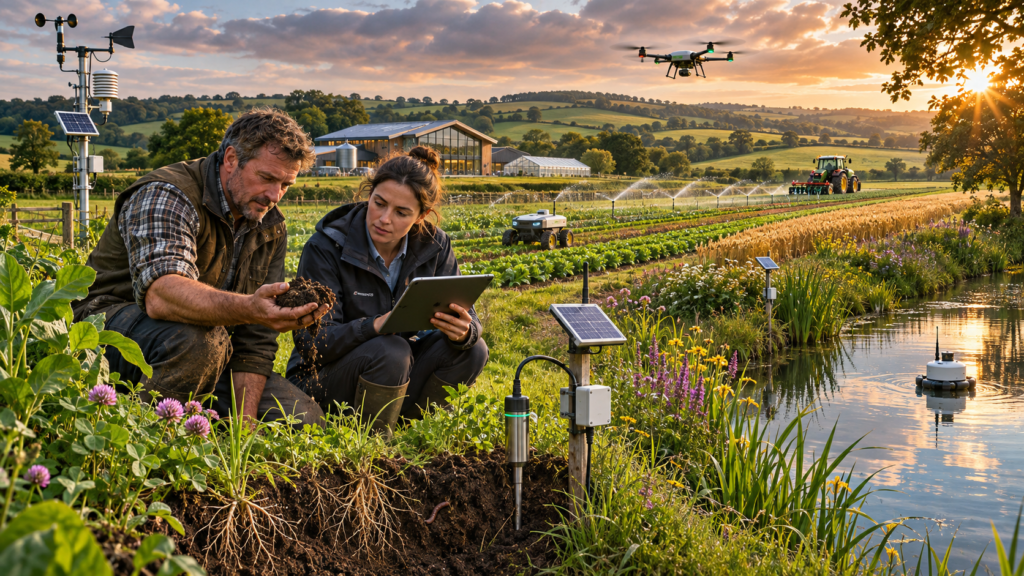
Artificial intelligence, satellite monitoring, nutrient recovery and advanced sensing technologies could help farmers and growers reduce production costs, improve productivity and strengthen environmental resilience.
The UK Government has opened a £28 million innovation funding competition designed to accelerate the development of commercially viable technologies that address some of the most pressing environmental challenges facing English agriculture and horticulture.
Delivered by Defra in partnership with Innovate UK, the Healthy Soils and Water for a Sustainable Environment competition forms part of the Government’s Farming Innovation Programme, with an emphasis on translating research and technological development into practical solutions that deliver measurable benefits for farming businesses.
The funding forms part of a wider £43 million package announced by Environment Secretary Dame Angela Eagle, which includes up to £15 million to support agricultural water storage projects.
With growers facing mounting input costs, increasingly unpredictable weather patterns and growing pressure to improve environmental performance, the initiative represents a significant opportunity for agritech developers to bring new technologies closer to commercial adoption.
Moving Innovation from the Laboratory to the Field
A central requirement of the competition is the continued involvement of farmers, growers and foresters throughout the development process.
Rather than developing technologies in isolation, successful applicants will need to demonstrate how their innovations can address genuine operational challenges and deliver commercially meaningful results.
Potential applications include precision nutrient management, intelligent irrigation, soil diagnostics, environmental sensing and technologies capable of reducing nutrient losses.
Projects must have a UK-registered commercial organisation as their lead applicant, working alongside at least one additional commercial or research partner. Eligible projects will have total costs of between £1 million and £5 million and can run for up to three years.
AI and Satellite Technology Deliver Promising Results
One of the most commercially promising examples of previous Government-backed innovation comes from Messium, which is developing a precision nitrogen management platform using satellite imagery and artificial intelligence.
The project, awarded £759,382 in funding, combines satellite observations with weather information to help growers determine when and how much nitrogen fertiliser to apply.
By identifying variations in crop requirements across individual fields, the technology could help growers reduce unnecessary fertiliser applications without compromising productivity.
Following two seasons of commercial farm trials, the project team has reported gross margin improvements of more than £75 per hectare in its best-performing fields compared with standard farm practice.
Although further evaluation is required, the findings demonstrate the potential for AI-powered crop management to deliver both economic and environmental benefits.
Turning Agricultural Waste into Valuable Resources
Innovation in nutrient recovery is also gathering pace, with technologies emerging that could reduce Britain’s dependence on imported artificial fertilisers.
ElentecBioAg, working with Harper Adams University and commercial partners, is developing a system that uses electrocoagulation to recover valuable nutrients from dairy slurry.
The technology separates nitrogen and phosphorus into distinct fractions, allowing growers to apply nutrients more precisely according to crop requirements.
Meanwhile, Black Bull Biochar is leading a £760,000-funded project to develop ChickenChar, a range of biochar products designed to improve nutrient retention in poultry litter.
The ambition is to reduce ammonia emissions while creating a more effective organic fertiliser, potentially delivering financial benefits for growers alongside improved environmental performance.
Both projects highlight the growing commercial potential of circular agricultural systems, where materials traditionally regarded as waste become valuable production inputs.
Unlocking the Secrets of Soil Biology
Understanding the biological health of soils remains another significant opportunity for agritech innovation.
Verdant Carbon, working alongside the National Institute of Agricultural Botany (NIAB), has been developing an approach to soil testing that examines microbial activity and translates complex biological information into practical indicators for growers.
Such technologies could help producers make more informed decisions about soil management, crop nutrition and long-term productivity.
For horticultural businesses, the ability to identify deteriorating soil health before it affects crop performance could be particularly valuable, supporting preventative management rather than costly remedial intervention.
A Commercial Opportunity for Agritech Developers
The new funding competition comes at a time when the agricultural technology sector faces increasing pressure to demonstrate tangible returns on investment.
For growers, the value of innovation ultimately lies in its ability to reduce operating costs, improve production efficiency and protect profitability.
For technology developers, the £28 million funding opportunity offers a route to validate emerging solutions under commercial conditions, establish meaningful partnerships with growers and overcome some of the financial barriers associated with bringing new products to market.
The challenge will be ensuring that successful innovations are not only technically impressive but also affordable, scalable and straightforward to integrate into existing farming operations.
Applications Now Open
Applications close at 11am on 28 January 2027, with successful applicants expected to be notified on 27 May 2027. All funded projects must commence by 1 August 2027.
Interested businesses can access the full eligibility criteria and application guidance through the Innovation Funding Service.
For an agricultural industry increasingly challenged by resource availability, climate volatility and rising production costs, the competition presents an opportunity to demonstrate that environmental sustainability and commercial profitability can go hand in hand.