The food industry absolutely loves a trend. One minute everybody is drinking charcoal smoothies and eating activated almonds, the next they’ve vanished without a trace; abandoned somewhere between the reduced aisle and social media oblivion.
But some of the innovation trends emerging this year feel very different. They’re not just marketing gimmicks wrapped in compostable packaging. They’re being driven by genuine shifts in consumer behaviour, advances in technology and growing pressure on the global food system itself.
And increasingly, agritech is sitting right in the middle of all of it!
From AI-designed food products and precision farming to the rise of functional nutrition linked to GLP-1 weight-loss drugs, the relationship between agriculture, science and food manufacturing is becoming far more interconnected than many people perhaps realise.
Food Is Becoming More Functional
Consumers are no longer simply asking whether food tastes good. They want to know what it does.
Does it support gut health? Is it high in protein? Will it keep them fuller for longer? Does it help energy levels? Sleep? Recovery?
The rapid rise of GLP-1 medications has accelerated this dramatically. Food manufacturers are now reformulating products for consumers who are eating smaller portions but still need nutrient-dense foods packed with protein, fibre and functional ingredients.
That shift is creating opportunities right across the supply chain.
Growers are increasingly under pressure to deliver crops with stronger nutritional profiles and greater consistency, while food developers are leaning heavily into ingredients that can support health claims without making products feel overly clinical or joyless. Because let’s be honest — nobody wants their lunch to feel like a medical appointment.
Protein-rich snacks, enhanced dairy products and functional beverages are all seeing strong momentum, and it’s clear this is no longer a niche wellness category. It’s becoming mainstream!
AI Is Starting To Change Food Development
Artificial intelligence is quietly becoming one of the food industry’s most influential tools.
Not in some dramatic “robots replacing farmers” way, but in a much more practical sense.
AI is increasingly being used to predict flavour combinations, speed up product development, reduce waste and improve formulations before products even reach physical testing stages. That matters in an industry where failed launches are expensive and margins are often painfully tight.
Researchers are already experimenting with AI-generated recipes designed to optimise sustainability, nutrition and taste all at once. Meanwhile, upstream on farms, AI-powered precision agriculture systems are helping growers monitor crop performance, reduce inputs and gather increasingly valuable data about quality and yield.
That data is becoming commercially important because food companies now want far more visibility into where ingredients come from and how they’re produced.
In many ways, farming is becoming as much about data generation as food generation.
Sustainability Is Growing Up
Consumers have also become far more sceptical about vague sustainability claims.
A green leaf slapped onto a label and a few carefully chosen buzzwords simply aren’t enough anymore.
People increasingly want proof. They want traceability. They want transparency. They want to understand how products are grown, transported and produced.
As a result, the industry is investing heavily in technologies that can verify environmental performance properly, from digital traceability systems and smart packaging through to precision farming platforms and advanced monitoring tools.
Precision fermentation is another area attracting enormous attention. While it’s unlikely to replace traditional agriculture altogether, many experts believe fermentation technologies could become an important complementary tool for producing proteins and speciality ingredients more sustainably.
The future increasingly looks less like a battle between technology and farming, and more like a collaboration between the two.
Consumers Still Want Excitement
Of course, none of this means flavour suddenly stops mattering.
Consumers still want excitement, indulgence and novelty — which explains the continued rise of bold flavour mashups and sensory-led food experiences.
Sweet-and-spicy combinations, globally inspired flavours and unusual pairings continue to dominate innovation pipelines because people are still looking for food that feels fun and shareable.
But there’s also a balancing act emerging.
Consumers want adventurous products, but they also want authenticity. They’re becoming more wary of ultra-processed foods and artificial ingredients, even while embracing innovation elsewhere.
That tension is shaping much of the industry’s current thinking. The challenge now is creating products that feel modern and exciting without feeling fake or over-engineered.
Not always an easy task in a world where some ingredient lists still read like chemistry homework.
Agritech Is Becoming Central To The Conversation
Perhaps the biggest shift of all is that agritech is no longer operating quietly in the background.
It’s becoming fundamental to how future food systems function.
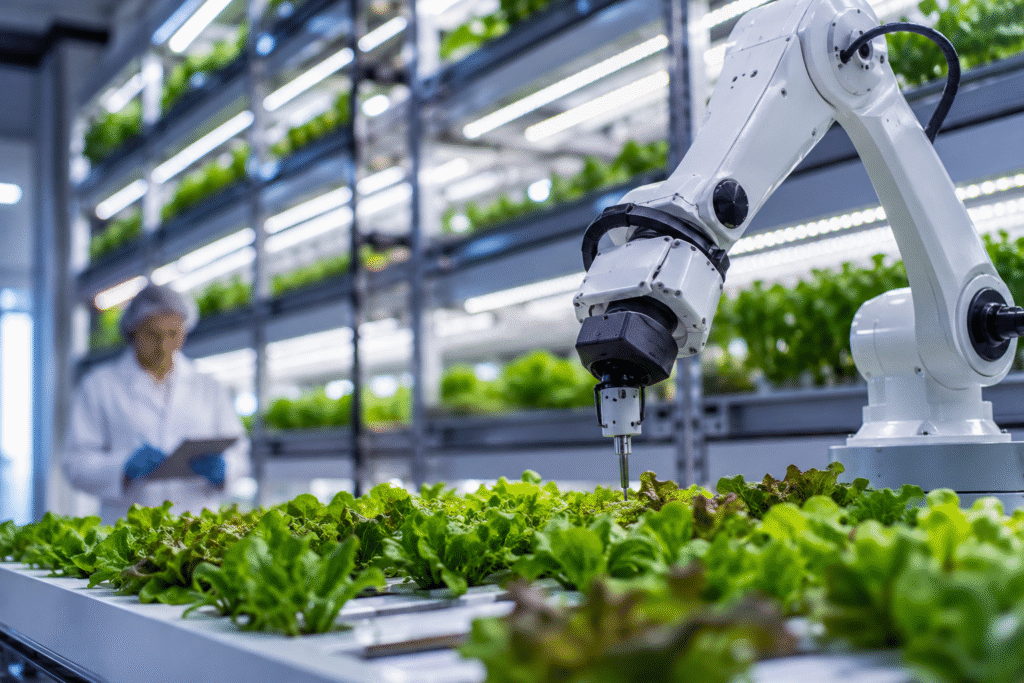
Whether it’s AI-powered crop management, precision farming, controlled-environment agriculture or data-driven supply chains, technology is increasingly influencing not just how food is grown, but how products are developed, marketed and trusted by consumers.
The lines between agriculture, food science and technology are blurring rapidly.
And while plenty of food trends will undoubtedly disappear as quickly as they arrived, the deeper shift towards smarter, more personalised and more transparent food systems looks very unlikely to fade anytime soon.