
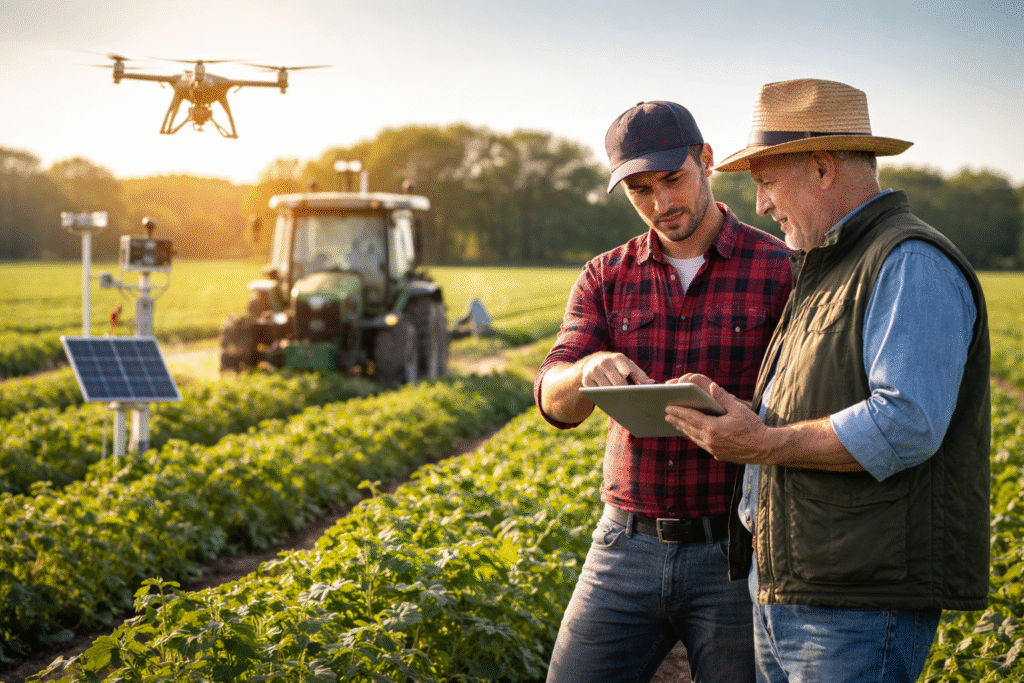
Agritech innovators must design technologies that integrate seamlessly with real-world farm operations and emerging digital standards if they are to accelerate the transition towards a more sustainable and resilient food system, according to new insights from the Carbon Trust.
The organisation argues that while agriculture sits at the centre of climate, environmental and food-security challenges, innovation alone is not enough. To scale effectively, agritech solutions must be built around the practical realities farmers face daily, while also aligning with the broader transformation of global food systems.
Bridging The Gap Between Innovation And Adoption
Farmers are increasingly being asked to produce more food while reducing emissions and improving resilience to climate change. At the same time, technology developers are racing to deliver solutions that can support climate-smart farming practices and strengthen food system resilience.
However, the Carbon Trust warns that the pathway from promising prototype to real-world impact can be slowed by several common barriers — including fragmented digital systems, lack of interoperability and tools that fail to reflect real farming workflows.
According to the organisation, successful technologies are typically those designed in collaboration with farmers and built to slot naturally into existing routines rather than forcing producers to adapt to new, complex processes. Solutions that minimise manual data entry and deliver immediate time-saving benefits are particularly likely to gain traction on farms.
Interoperability And Data Standards Are Critical
Another key factor highlighted by the Carbon Trust is the importance of interoperability. Closed technology ecosystems can slow adoption by creating barriers for farmers and supply-chain partners trying to integrate different systems.
Instead, innovators are encouraged to develop open architectures, such as application programming interfaces (APIs), and align with emerging industry data standards so that their technologies can connect easily with existing farm management platforms.
This approach reduces friction across the supply chain and helps ensure that agritech tools contribute to the wider digital transformation of agriculture, often referred to as “digital agriculture” — where data-driven technologies support better decision-making and resource efficiency throughout the food system.
The Importance Of Policy Stability And Long-Term Alignment
Beyond technology design, the Carbon Trust also stresses the need for greater clarity and long-term alignment across the agricultural ecosystem.
Start-ups and innovators require confidence that emerging sustainability standards, policies and supply-chain requirements will remain stable long enough to justify investment and product development. Clear signals from governments, retailers and industry partners can therefore play a decisive role in accelerating adoption.
Programmes such as the Food Agriculture System Technology Accelerator (FASTA), delivered by the Carbon Trust in partnership with the UK Agri‑Tech Centre, aim to help early-stage companies overcome these barriers and scale technologies capable of supporting low-carbon, resilient farming systems.
A Systems Approach To Agritech Innovation
Ultimately, the message from the Carbon Trust is that the next wave of agritech innovation will succeed not simply because it is technologically advanced, but because it is practical, interoperable and aligned with the needs of farmers and the wider food supply chain.
By designing solutions around real-world farming workflows, embracing open data standards and building long-term partnerships across the agri-food sector, innovators can significantly accelerate the transition to a sustainable and resilient agricultural future.
