
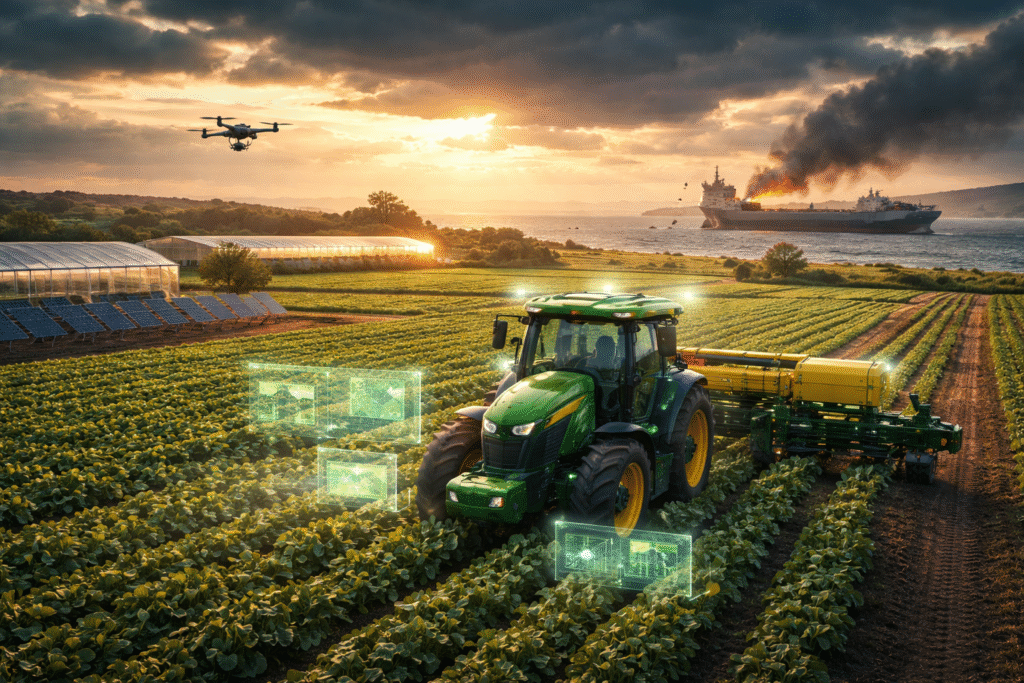
The escalating conflict involving Iran has sparked renewed calls for the UK to accelerate investment in agritech, as policymakers warn that global instability is once again exposing the fragility of Britain’s food system.
Speaking in response to the crisis, George Freeman highlighted the critical role of agricultural innovation in safeguarding long-term food security, describing the situation as a “wake-up call” for Government and industry alike.
The disruption to global supply chains—particularly in fuel, fertiliser and agrochemicals—has already begun to ripple through the agri-food sector, increasing production costs and amplifying risks for both farmers and consumers. These pressures are being compounded by the UK’s structural reliance on imports and energy-intensive food systems, leaving domestic production exposed to geopolitical shocks.
Industry leaders and policymakers argue that agritech innovation will be central to addressing these vulnerabilities. Advanced technologies, including precision farming, automation and controlled-environment agriculture, are increasingly viewed as essential tools to boost productivity, reduce input dependency and strengthen resilience across supply chains.
The latest crisis mirrors previous global shocks—from the war in Ukraine to pandemic-related disruption—which have repeatedly demonstrated how quickly food systems can come under strain. Rising energy costs linked to Middle East instability are already driving up fertiliser and fuel prices, placing further pressure on farm margins and threatening future output.
Experts warn that without decisive action, such disruptions could translate into sustained food price inflation and reduced availability, particularly in sectors reliant on imports or high energy inputs, such as fresh produce and horticulture.
Against this backdrop, there is growing consensus that agritech must move from a “nice-to-have” innovation agenda to a core pillar of national food strategy. Strengthening domestic production through technology-led solutions, alongside more resilient and diversified supply chains, is increasingly seen as critical to mitigating future shocks.
As geopolitical tensions continue to reshape global trade flows, the message from across the sector is clear: investment in agritech is no longer optional—it is fundamental to securing the UK’s food future.
