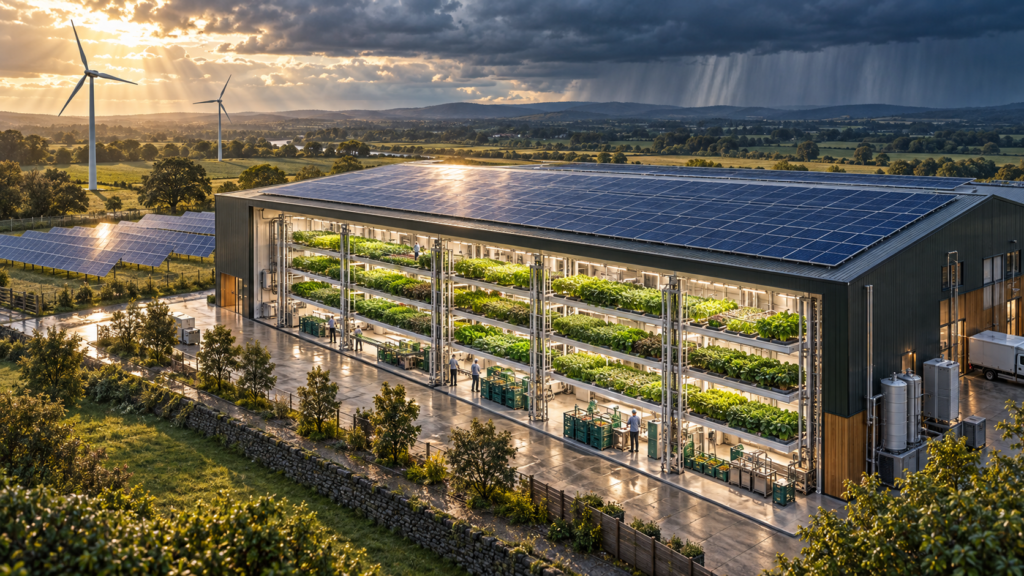
Vertical farms could give fresh food supplies greater protection from extreme weather. Making that protection affordable will depend on how they generate, buy and use electricity.
A crop grown indoors does not have to wait for rain or survive a late frost. Its grower can set the temperature, supply water directly to the roots and decide when the lights come on.
That control gives vertical farming a credible role in strengthening food security. For suitable crops, it offers the prospect of regular harvests with less exposure to the weather that makes outdoor production unpredictable.
Researchers at Wageningen University & Research describe systems capable of producing vegetables even in deserts or cold, dark environments. But maintaining those conditions takes considerable energy. Protecting crops from the weather therefore creates another dependency: a reliable electricity supply at a price the business can afford.
Vertical farming cannot remove climate change from the food system. Extreme weather can still damage buildings, disrupt electricity networks and interrupt deliveries. Heat outside the building can also increase the work required to keep crops cool.
Its contribution is more specific, and still valuable: reducing the direct exposure of selected crops to outdoor conditions while adding another source of supply.
Growing in stacked layers makes intensive use of the building footprint, while recirculating water and nutrients can reduce resource consumption. Research published by Wageningen in March 2026 highlights these efficiencies, alongside the importance of clean energy in determining a vertical farm’s carbon footprint.
The strongest near-term role remains in fresh greens, herbs and other suitable horticultural crops. Producing these reliably can support access to fresh food, but it does not replace the cereals and other staples that supply much of the world’s dietary energy. Crop choice, production costs and access to buyers remain fundamental to commercial viability.
Solar power is an obvious option for operators seeking greater control over energy costs. Panels on a warehouse roof or neighbouring land could supply electricity for lighting, pumps and environmental controls, reducing purchases from the grid when generation coincides with demand.
However, stacking crops does not create additional roof space. Each growing layer needs light, while the building above it has a finite area available for panels. Research examining the relationship between photovoltaic generation and vertical cultivation shows why the land needed to power a farm must be considered alongside the space occupied by its crops. Rooftop solar should therefore be treated as a potential contribution, rather than assumed to provide complete energy independence.
The practical calculation is site-specific: how much electricity the farm needs, how much the proposed installation can generate, and how closely those two patterns match.
Solar produces nothing at night and varies with weather and season. Batteries can move some daytime generation into later hours, but they add investment costs and lose some energy during charging and discharge. They also need sufficient capacity for the job expected of them.
Wind generation could provide another source where local conditions are suitable. Combining technologies may spread production across more hours, although it cannot guarantee uninterrupted supply. A farm planning to operate independently would still need to demonstrate how it could maintain essential systems during prolonged shortages of renewable generation.
These are engineering and commercial choices, not a universal recipe for cheap power. A research viewpoint in Frontiers in Science identifies photovoltaics as part of the solution while stressing that their manufacture, installation and eventual disposal carry financial and environmental costs.
There are other ways to generate energy locally. Anaerobic digestion breaks down organic materials, including food waste and manure, to produce biogas. That gas can generate electricity and supply heat, or support cooling systems. For a vertical farm near an existing digester or a dependable source of suitable waste, it is an option worth investigating.
The economics would depend on feedstock availability, equipment, operating costs and the amount of useful energy recovered. A farm should not assume its own crop residues could meet its power demand without a proper energy balance.
Generating electricity is only part of the opportunity. Using less of it for each saleable kilogram could be just as important.
Wageningen researchers have examined varying light intensity in response to plant needs and electricity prices. Their modelling indicated a 12 per cent reduction in electricity costs through changes in light intensity during the day. Tests with leafy vegetables, including spinach, found no negative growth effects under the variable lighting conditions studied. The findings are promising, although they are not a guarantee of equivalent savings across every commercial farm.
For operators, the implication is to design energy supply and crop production together. Lighting schedules, cooling requirements, renewable generation and crop development need to work as one system. Simply adding more light may raise the electricity bill without delivering enough additional saleable produce to justify it.
That also changes how success should be measured. Yield per square metre matters, but so do electricity use per kilogram, crop losses and the cost of delivering a consistent product to the customer.
For Britain, the opportunity is to build vertical farms into a broader supply system that also includes field production, greenhouses and imports. A well-run indoor farm could provide dependable volumes of particular crops when other sources are under pressure.
Whether it strengthens food security will ultimately depend on whether those harvests remain affordable. Clean generation, efficient growing systems and reliable power can help bring that goal closer. They need to be part of the farm’s design from the outset.